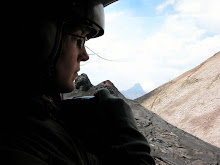
In this view, Volcán Barú has a few clouds gathering around the summit but otherwise there's hardly a breath of moisture in the air. The intervening "hummocks" in the fore-and-middle ground are dusty and brittle grass covers the slopes. But this weather won't last long. Despite how brutal the Death Valley-like weather is for hiking and traversing the campo, I'm not looking forward to the polar opposite: knee-high mud and drenched notes.
In anticipation of the winter rains, I've packed in 2 weeks of fieldwork... más o menos. A modified Debris Avalanche map has come from this as well as many new outcrop descriptions and field photos. Should I post the new gritty details? I don't think I have time and it might not be as interesting to read as it would be to type. But regardless, I'd like to share some of the most interesting photos from last week.
 I haven't spent a lot of time on the Rio Chiriqui Viejo, but each time I visit it, I'm never disappointed; there is always something interesting to see. This time, I saw Squirrel Monkeys (thanks for the correction Holly!). Maybe I've seen these small, masked critters in photos, but never live, in the wild. This view shows 3 of them playing in a tree high above the riverbank. What the photo doesn't show is the object of their game: a white, black-speckled bird of prey that was circling the tree.
Aaaah, the benefits of a good zoom, here's a portrait of a member of the trio.
 Southeast of the Rio Chiriqui Viejo are several other rivers. An important one figuring into my mapping project is the Rio Divalá. While there might be a few small families of Squirrel Monkeys close to the Pacific coast, there are MANY clans of Howler Monkeys. I've spent more than a year in Panamá and I've hardly seen so much wildlife so often - the following photo was taken AFTER the howling began.
 Have you ever heard anything like this?
The following photo isn't mine, but I wish it was. There have been so many times when I've seen a
 Blue Morpho butterfly - whether out of the corner of my eye or disappearing into the shadows - that it is starting to drive me crazy. These are beautiful marvels, something you can't observe wild in the USA and yet, every time I see the flash of blue, there is never enough time to pull out the camera and focus in on the insect. These butterflies are just that fast. Like the day I spent walking the upper reaches of Rio Piedra: I saw the Blue Morpho in the shadows, immediately dropped my backpack to the ground, pulled open the drawstrings, unzipped the camera case, pressed "Power," and... the butterfly was gone. I even ran into the trees looking for it and, nope, sorry, "ya se fue," I couldn't find it with my naked eye, never mind the camera lens. But to represent it's presence, I'm using this photo from: http://www.yesnet.yk.ca/schools/wes/webquests_themes/butterfly_lucille/butterfly_species/morpho/index.html
Oh, I'll keep trying - I'll keep looking out for those beautiful wings. Besides, it's flashing my favorite color and few things can wear blue so nicely.